
Published October 1, 2025
How a Government Shutdown Could Affect the Real Estate Market

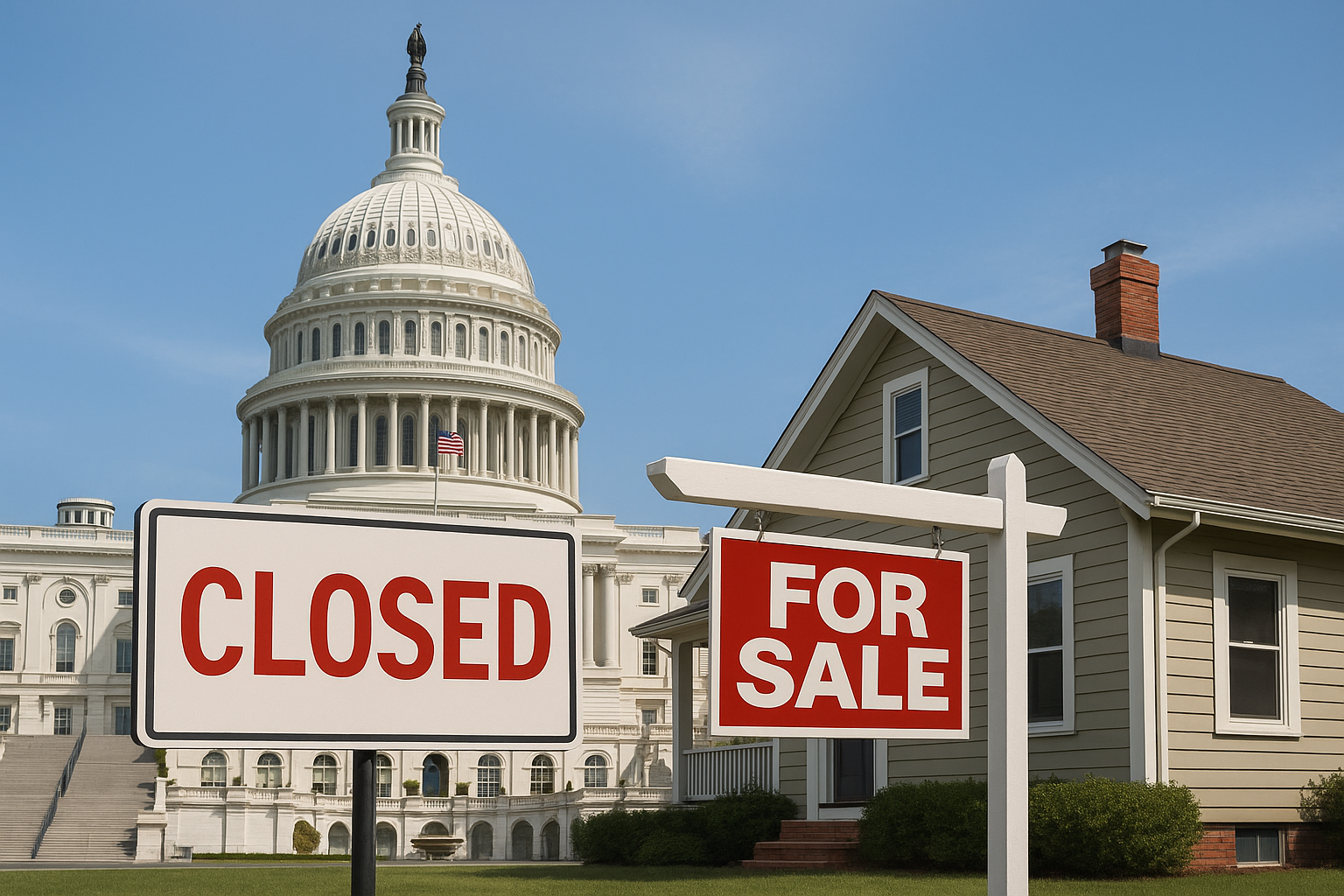
Government Shutdown — Impacts on Home Buyers, Sellers, and the Housing Market
A government shutdown might seem like a distant political drama in Washington, D.C., but its ripple effects can hit close to home for buyers and sellers. From delayed mortgages and frozen housing programs to shifts in interest rates, a federal shutdown introduces new hurdles into an already complex real estate market. In this article, we’ll explore why government shutdowns matter for real estate, what kinds of challenges home buyers and sellers could face, and how to navigate the uncertainty with an informed game plan.
Why a Government Shutdown Matters in Real Estate
The health of the housing market is closely intertwined with government activity. Many aspects of buying or selling a home rely on federal agencies or programs, meaning a shutdown can quickly create bottlenecks. For instance, roughly one-quarter to one-third of all mortgages (especially for first-time buyers) are secured through government-backed programs like FHA and VA. If those agencies slow down, loan approvals can stall. Similarly, the National Flood Insurance Program (NFIP) underpins nearly half a million home sales each year, contributing about $70 billion to the economy. When Washington fails to fund agencies and programs on time, it isn’t just a political issue — it’s an economic one that can trickle down to individual home purchases and sales.
Beyond the direct ties, there’s also the matter of confidence. Real estate transactions are major financial decisions often influenced by broader economic sentiment. According to Lawrence Yun, chief economist of the National Association of REALTORS®, government shutdowns add an “unnecessary complication” and undermine consumer confidence in the economy. If buyers and sellers start feeling uncertain about the future (or about their jobs in the case of federal employees), they may hesitate on moving forward with a purchase or sale. In short, a shutdown creates headwinds for the real estate market by tangling up essential services and rattling the nerves of market participants.
Immediate Impacts on Home Buyers
Mortgage Application Delays: Home buyers seeking government-backed mortgages could experience delays during a shutdown. Programs like FHA (Federal Housing Administration), VA (Department of Veterans Affairs), and USDA rural home loans all depend on federal offices to guarantee or process the loans. In past shutdowns, FHA continued to endorse new single-family loans but with reduced staff, slowing things }. VA loan processing also continued with limited staffing, leading to potential slowdowns in getting approvals, appraisals, or Certificates of Eligibility.USDA loans are hit even harder — the U.S. Department of Agriculture typically halts **all new** rural home loans during a shutdown, meaning buyers needing a USDA mortgage might be stuck waiting until funding resumes. If you’re a buyer using one of these programs, be prepared for a longer timeline than usual.
Verification Roadblocks: Even buyers with conventional (non-government) mortgages can run into snags because lenders often rely on federal data. For example, banks verify your income and tax returns through the IRS and check Social Security numbers through the SSA. In a shutdown, the IRS may suspend processing of tax transcript requests (Form 4506-T), and Social Security number verifications could be delayed if staff are furloughed. Lenders do have workarounds — Fannie Mae and Freddie Mac (which back most conventional loans and are not funded by Congress) have in the past allowed certain verifications to happen just before closing or even after closing, once the government reopens. Still, these temporary fixes require caution. As a buyer, you might need to sign additional paperwork or be ready for last-minute checks when the government is back in action.
Flood Insurance Snags: Purchasing a home in a flood zone? A shutdown could throw a wrench in the works. The National Flood Insurance Program (NFIP), managed by FEMA, cannot issue new policies or renewals during a lapse in funding. This is critical because lenders by law require flood insurance on properties in designated floodplains. In past shutdowns, regulators have sometimes allowed closings to proceed without the usual flood insurance requirement, but that comes with risk. If a flood were to occur during the interim, it’s unclear if damage would be covered retroactively once the program is restored. Private flood insurance might be an alternative some buyers consider, but those policies can be more expensive or hard to get on short notice. For buyers, the best strategy if you’re in contract for a home that needs flood insurance is to secure the policy **before** a shutdown hits, or be ready to postpone closing if you can’t get coverage in time.
Interest Rates and Financing Costs: One silver lining for buyers is what can happen with mortgage interest rates. Markets often react to the uncertainty of a shutdown by seeking safer investments, which means investors buy more U.S. Treasury bonds. When demand for bonds goes up, their yields (interest rates) tend to go down — and mortgage rates often follow the 10-year Treasury yield’s direction. Historical data shows that during the 16-day shutdown in 2013, mortgage rates actually drifted lower overall. During the record 35-day shutdown of 2018-2019, rates initially dropped as well, though they bounced back to prior levels before the shutdown ended. Lower rates can make home loans more affordable, potentially bringing some relief to buyers struggling with high costs. However, any benefit from slightly lower rates could be offset by the delays and headaches mentioned above. Also, if a shutdown drags on and starts to disrupt government economic reports (like jobs or inflation data), the resulting uncertainty can make financial markets volatile. In short, don’t count on a shutdown to magically improve borrowing costs; the effect on rates is unpredictable and usually modest.
Psychological Effects on Buyers: Buying a home is as much an emotional decision as a financial one. News of a government shutdown, especially if it dominates headlines for days or weeks, can create a sense of unease. Some buyers may take a “wait and see” approach, pausing their home search until the federal government is back to normal operations. This is especially true for buyers who are federal employees or depend on income from government contracts — if they’re furloughed (temporarily unpaid) or at risk of job loss, they might not want to commit to a large purchase. Even those not directly affected could worry about the economy tipping into a slowdown. The good news is that in previous shutdowns, any dip in buyer demand was generally temporary. Once the budget impasse is resolved, confidence tends to return relatively quickly, and those sidelined buyers often re-enter the market.
Immediate Impacts on Home Sellers
Sellers feel the effects of a shutdown mainly through the eyes of their buyers. If a chunk of would-be buyers are delayed in getting financing, that can mean fewer offers coming in and longer time on market. For example, if you’re selling a home that appeals to first-time buyers, be aware that many of them rely on FHA loans. During a shutdown, FHA loan processing continues but at a reduced pace:, so an FHA buyer’s approval might take longer than usual. The same goes for VA loans if you’re in a market with many military buyers. As a seller, this doesn’t mean you should avoid such buyers, but you’ll want to exercise patience and maintain good communication. It may take an extra couple of weeks for the loan to close through no fault of the buyer.
Sales in certain areas can feel an acute impact. If your property is in a rural area and the buyer was counting on a USDA loan, that sale could be put on hold entirely until the government reopens. Likewise, if you’re selling a home in a coastal or low-lying region that requires flood insurance, a shutdown of NFIP can halt the deal at the last minute if insurance can’t be bound. These situations are frustrating, but often it’s a timing issue rather than a deal-breaker. Most buyers will still want the home; they just can’t satisfy the lender’s requirements until federal operations resume. One thing to note: private flood insurance markets or portfolio lenders (local banks that keep loans in-house) sometimes step in to fill gaps during a shutdown. It might be worth discussing with your real estate agent if there are any creative solutions to keep the sale on track.
In terms of pricing and demand, a short-term government shutdown by itself historically hasn’t crashed housing prices or sales volumes nationwide. The overall effect tends to be more of a delay than a true loss of sales. In fact, a National Association of REALTORS® survey after the 2019 shutdown found 75% of real estate professionals reported no impact on their contracts or closings, though about 11% did report having a deal delayed or lost due to the shutdown. This suggests most transactions eventually go through, but sellers should be prepared for the possibility that your buyer might need an extension on their closing date. Staying flexible and understanding can go a long way. Remember, the delay is likely stemming from bureaucracy in Washington, not cold feet from the buyer. Working together, both parties can often find a way to adjust the timeline and complete the sale once the gears of government start turning again.
Finally, consider the broader buyer pool. A lengthy shutdown that draws a lot of news coverage might cause some buyers to step back temporarily, which in turn could mean fewer showings for your listing. On the flip side, those who continue home shopping amid the uncertainty might be more **serious** buyers rather than tire-kickers, since casual shoppers could be taking a break. It’s a subtle dynamic, but one that anecdotally some agents observe during disruptions. As a seller, keep your home in show-ready condition and continue your marketing efforts; serious buyers are still out there. Any slowdown in activity will likely be short-lived, with potentially a rebound of pent-up demand once the situation in D.C. is resolved.
Impact on Housing Programs and Loans
Not all parts of the housing system come to a halt in a shutdown — many continue with reduced capacity or contingency plans. Here’s a rundown of key housing programs and how each is affected:
- Federal Housing Administration (FHA): The FHA will typically keep endorsing new single-family mortgages during a shutdown, deeming it an essential service. That means if you’re getting an FHA loan, it’s likely to still be processed, but expect slower turnarounds. Niche products like FHA reverse mortgages or certain renovation loans (Title I) may be put on pause. Also, FHA condo project approvals could be delayed since they require staff review}. Essential operations for loans already in place (like servicing and insurance claims) continue, often through automated systems or contractors.
- Department of Veterans Affairs (VA): VA home loans will continue to be guaranteed during a shutdown. Veterans can still apply and get loans, as the VA sees this as critical to veteran services. However, some support staff may be furloughed, which could slow things like appraisals or issuing your Certificate of Eligibility. Lenders often work through these minor delays, but if you’re a veteran buying a home, check in with your lender about any extra time needed.
- USDA Rural Housing Loans: This is one of the hardest-hit programs. The USDA typically stops processing new loan applications entirely during a shutdown. If you were eyeing a home in a rural area with a USDA loan (which offers zero-percent down payments), you’ll likely have to wait. Lenders might offer to switch you to a different loan type if possible, but many USDA borrowers choose that program for its unique benefits, so switching isn’t always feasible. Unfortunately, there’s not much workaround here — it’s a waiting game until the USDA staff return to work and loan funding is reactivated.
- National Flood Insurance Program (NFIP): As mentioned earlier, the NFIP cannot issue new policies or renew existing ones during a lapse. Home buyers can assume a seller’s existing flood policy if one is in place, but otherwise no new coverage is available until the program is funded again. Many states and banks have learned to temporarily waive the proof of flood insurance requirement for closing if a shutdown is in effect, but this isn’t a comfort to anyone involved. If you close without a new policy, you’re taking on risk. Alternatively, some private insurers offer flood policies; it’s worth getting a quote from them if you’re determined to close during the shutdown. Sellers in flood zones should encourage buyers to line up insurance as early as possible in the sale process to avoid last-minute surprises.
- Taxpayer Services (IRS verification): While not a “housing program,” IRS operations are crucial for many loans. During prior shutdowns, only a small fraction of IRS employees worked (mainly to process payments), and they did **not** issue tax transcripts or verify incomes. This means a lender might not be able to double-check a buyer’s tax return data. As noted, Fannie Mae and Freddie Mac have policies allowing some flexibility, such as closing a loan without the transcript in hand, then verifying later. This is one area where having an experienced lender helps; they’ll know what’s permissible to keep the loan moving and what absolutely requires waiting for the IRS to reopen.
- Housing Assistance and Rentals: Programs like Section 8 housing vouchers and public housing funds aren’t typically top-of-mind for home buyers or sellers, but they matter in the broader housing ecosystem. During a short shutdown, Housing and Urban Development (HUD) can usually keep rental assistance payments flowing to landlords and keep existing grants going. However, if the shutdown persists beyond a few weeks, new funding for vouchers or affordable housing grants gets frozen. In a long standoff, some landlords with voucher tenants might start feeling the pinch if payments are delayed, and that could trickle through local rental markets. For the for-sale market, the immediate impact here is limited, but it’s a reminder of how interconnected the housing system is with federal support.
It’s important to note that government-sponsored enterprises (GSEs) like Fannie Mae and Freddie Mac **do not shut down** because they don’t rely on annual congressional funding. They continue to operate normally, buying mortgages and issuing mortgage-backed securities. This keeps the conventional mortgage market functioning. The main hiccup for GSE loans, as discussed, is the inability to get certain verifications from federal agencies on time. Also, federal data reports that inform interest rate pricing (like home price indices from the FHFA, or economic indicators) might be delayed. All these factors combined mean that while the housing market doesn’t come to a full stop during a shutdown, it often hits a slower gear, running on reserve power until full operations resume.
Broader Economic Ripple Effects
A government shutdown doesn’t only impact those directly using federal programs; it can also send shockwaves through the broader economy, which in turn affect real estate. One major factor is consumer confidence. People hear the news about political gridlock and might worry about the stability of their jobs or the economy at large. As Yun pointed out, it creates a “perception of a chaotic environment” that isn’t helpful when making a big decision like a home purchase. If enough people become skittish, the housing market could see a dip in activity. Home sales had already been sluggish in the lead-up to this shutdown, due to high prices and interest rates, and a shutdown could be an extra chill on buyer enthusiasm.
Another consideration is how a shutdown might influence the Federal Reserve’s actions on interest rates. The Fed isn’t part of the federal budget and won’t shut down; however, it heavily relies on economic data (much of it produced by government agencies) to make decisions. During a shutdown, reports like the monthly jobs numbers or inflation readings might be postponed. This puts the Fed in a tough spot — they may delay policy changes if they’re “flying blind” without fresh data. Financial markets, too, can get choppy when data is missing, because investors hate uncertainty. Volatile markets can indirectly affect mortgage rates and the availability of credit. The irony is that while short shutdowns often see mortgage rates dip slightly due to a flight-to-safety, a longer shutdown that clouds the economic outlook could spook markets in the other direction or cause see-sawing rates. For real estate, stable and predictable economic conditions are best; uncertainty is the enemy of long-term planning for buyers, sellers, and builders alike.
Lastly, consider regional impacts. Areas with a high concentration of federal workers or contractors (think Washington D.C., Northern Virginia, parts of California or Alabama with big federal facilities, etc.) might feel the crunch sooner. If thousands of employees are furloughed, local businesses suffer, and some households might decide to postpone buying or selling until their income is secure again. Similarly, markets that rely on government-supported industries (like a town with a big military base or NASA center) could see a temporary pullback in housing demand. On the other hand, a brief shutdown that is resolved in a week or two may not leave any lasting scar. The pent-up demand often means that any sales delayed in the downtime simply occur later, bunching up activity right after the government reopens. In fact, after the 35-day shutdown in 2018-2019 (the longest in history), existing-home sales did decline during that period, but they rebounded shortly thereafter. The housing market’s trajectory is ultimately driven by fundamentals like employment, interest rates, and consumer needs. A shutdown is more like a speed bump than a brick wall if it doesn’t drag on too long.
How to Navigate a Shutdown: Tips for Buyers and Sellers
Dealing with a home purchase or sale during a government shutdown isn’t ideal, but it’s also not the end of the world. Both buyers and sellers can take proactive steps to mitigate the impact. Here are some strategies to consider:
Advice for Home Buyers
- Communicate Early and Often: Stay in close contact with your lender, real estate agent, and (if you’re already in contract) the seller’s agent. Ask your lender if any of your loan verifications or insurance requirements depend on federal agencies, and discuss contingency plans. Lenders might have strategies, such as proceeding with alternatives for verification or waiting to lock your interest rate if market volatility is high.
- Get Your Documents in Order: Make sure you’ve provided all required documents to your lender to avoid any additional delays. While you can’t control an IRS slowdown, you can control things like bank statements, pay stubs, and proof of employment. The goal is to ensure that when the government reopens, your file is otherwise ready to go.
- Be Flexible with Timing: If possible, build some flexibility into your closing date. Rather than a hard deadline, consider agreeing with the seller on a range or an extension clause that accounts for shutdown-related delays. This can reduce stress if your loan is temporarily stuck in limbo waiting for a form or approval.
- Consider Rate Locks Carefully: In a volatile situation, mortgage rates can move. If rates have dipped during the shutdown, you might benefit from that by locking in a low rate. However, consult with your lender on how long the lock should be. You may need a slightly longer lock period than normal to account for processing delays. Some lenders offer “lock and shop” or extended rate locks for a fee — weigh those options if you’re worried about the timeline.
- Explore Alternatives: If your situation is urgent (say, your lease is ending or you’ve already sold your previous home), talk to your lender about whether there are alternative loan products that could work. For example, if a USDA loan is off the table due to the shutdown, could you qualify for an FHA or conventional loan instead? Not everyone will have multiple options, but it doesn’t hurt to ask.
- Stay Calm and Patient: This advice sounds simple but matters a lot. Buying a home is stressful enough, and a shutdown can test anyone’s patience. Remember that many others are in the same boat, and eventually the government will reopen. Focus on what you can control (getting documents ready, responding quickly to lender requests, etc.) and try to be patient with what you can’t control. As one mortgage industry piece noted, frustration during the 2018-2019 shutdown was high, but maintaining open communication and flexibility helped most buyers eventually close their deals.
Advice for Home Sellers
- Know Your Buyer’s Situation: It’s perfectly fine (in fact, wise) to ask what kind of financing your buyer is using. If it’s FHA, VA, or USDA, recognize there could be delays. Work with your agent to set realistic expectations with the buyer’s side. If both parties know there’s a potential holdup due to external factors, it can reduce tension when waiting for loan approval.
- Build in Contract Protections: Your real estate agent can help add clauses or amendments to the purchase contract to account for a shutdown. For example, an addendum could state that both parties agree to extend financing and closing contingencies by a certain number of days if necessary due to a government shutdown. This way, you won’t be in breach of contract if the buyer’s lender simply cannot perform in time through no fault of the buyer.
- Stay Market-Ready: If your home isn’t under contract yet, continue to market it confidently. Don’t withdraw your listing out of fear. Serious buyers are still looking, and some might even see less competition if other shoppers hit pause. Make sure your home is showing at its best (good curb appeal, clean and staged interior) to attract the buyers who are out there. The shutdown news might actually weed out less committed buyers, so the ones who do visit your home could be quite motivated.
- Have a Backup Plan for Movers: If you’ve synced your sale with the purchase of your next home, a delay in closing can create a domino effect. Plan for contingencies: for instance, discuss with your movers or storage company what happens if you need to reschedule on short notice. It may also be possible to negotiate a short rent-back or occupancy agreement with your buyer (or vice versa) if closing is delayed but everyone still wants to move on time. Having these conversations upfront can make a big difference.
- Leverage Your Agent’s Expertise: This isn’t the first shutdown to affect real estate, and experienced realtors will have insights from previous episodes. They might know which local banks are more flexible or have seen creative solutions to keep deals together. Don’t hesitate to lean on that knowledge. Your agent is your teammate in this process and likely has a pulse on how the local market is reacting. They can also keep you updated on any news (for example, if Congress passes a quick funding bill to end the shutdown, you’ll want to know immediately).
Above all, keep perspective. A government shutdown is a temporary situation, but buying or selling a home is a long-term decision. Most transactions delayed by a shutdown do eventually close once federal operations resume. By staying informed, flexible, and empathetic to the other side’s challenges, you can navigate the turbulence. As one industry leader put it, “uncertainty is the curse of all markets”:}, but real estate professionals and consumers alike are used to adapting and finding solutions even in less-than-ideal conditions. With the right approach, you can get through the storm and reach the finish line on your home sale or purchase.
FAQ: Government Shutdown & Real Estate
Q: Will a government shutdown affect my ability to get a mortgage?
A: Yes, it can. If you’re applying for a government-backed loan like FHA, VA, or USDA, expect possible delays in the application process . Even conventional loans might face hiccups if lenders can’t get IRS income verifications or other federal confirmations quickly . The key is that the mortgage process may slow down, but in most cases it doesn’t stop completely. Work closely with your lender – they often have contingency plans to work around temporary roadblocks.
Q: How does a government shutdown impact mortgage rates?
A: Historically, mortgage rates tend to dip slightly during government shutdowns. Investors often flock to the safety of Treasury bonds in uncertain times, which can push down their yields and lead to lower mortgage rates better.com . For example, previous shutdowns in 2013 and 2019 saw modest decreases in interest rates initially better.com . However, these drops might be short-lived. If the shutdown drags on and creates more economic uncertainty or market volatility, rates could swing unpredictably newsweek.com . So, you might see a small benefit as a borrower, but it’s not guaranteed to last or to outweigh other issues like loan processing delays.
Q: Can I still close on a home purchase during a government shutdown?
A: In many cases, yes – closings can still happen, especially if you and the seller are prepared to be flexible. Private lenders continue to operate, and if your loan doesn’t require any immediate government verifications, you could proceed on schedule. That said, if your transaction requires something like a new flood insurance policy from NFIP or an IRS transcript, those are factors outside of your control. During the 2018-2019 shutdown (35 days), some home sales were delayed, and a few fell through, but the vast majority eventually closed once the shutdown ended . It’s wise to build in a time cushion on your contract and work with your agent and lender to navigate any obstacles.
Q: Are all types of mortgages and home sales affected equally by a shutdown?
A: No, the impact varies. Loans directly involving federal agencies feel it the most. FHA and VA loans will be slowed but likely still processed (with possible delays in appraisals or support services) . USDA loans typically cannot close at all until the government reopens . Conventional loans through Fannie Mae/Freddie Mac are less affected since those entities stay open, but they can still see minor delays if verifications through federal offices are needed . Home sales in flood-prone areas might hit a snag if a new NFIP policy is required and the program is on hold . Meanwhile, pure cash purchases or transactions with all-private services won’t notice much difference at all. In summary, the more your deal relies on federal channels, the bigger the potential impact.

Rob Henry
| Simplicity Real Estate Solutions
or another way